


This is the second article in a three-part series. Part One explores the superpowers of effective networks. Part Two examines the sources of resistance to network approaches—and why many of them are legitimate concerns rooted in real experiences of networks done poorly.
This is the article where we roll up our sleeves. Because the most important thing I can say after two articles arguing for the power of networks is this: networks done poorly are not just ineffective. They’re actually harmful. They waste people’s time, erode trust, and strengthen exactly the kind of narrative and emotional barriers that make the next attempt harder. The concerns named in Part 2 are real because bad networks are all to real.
So what separates a network that transforms a system from one that disappoints? I’ll share one perspective here.
I want to be honest about the nature of what I’m offering here. What follows is not a prescription or a formula. It’s a set of working hypotheses and conditions that CoCreative and our colleagues have observed across 60-plus networks over many years, patterns that seem to hold and that we’ve come to believe are genuinely enabling. But the picture isn’t complete. Systems change is too context-dependent, too alive, too adaptive, and too specific to the people and the moment for any framework to be the final word. So I’ll offer what we think we know, and at the end of this article, I’ll ask for what you know, because the most complete picture of what it takes will only emerge when more of us are in the conversation.
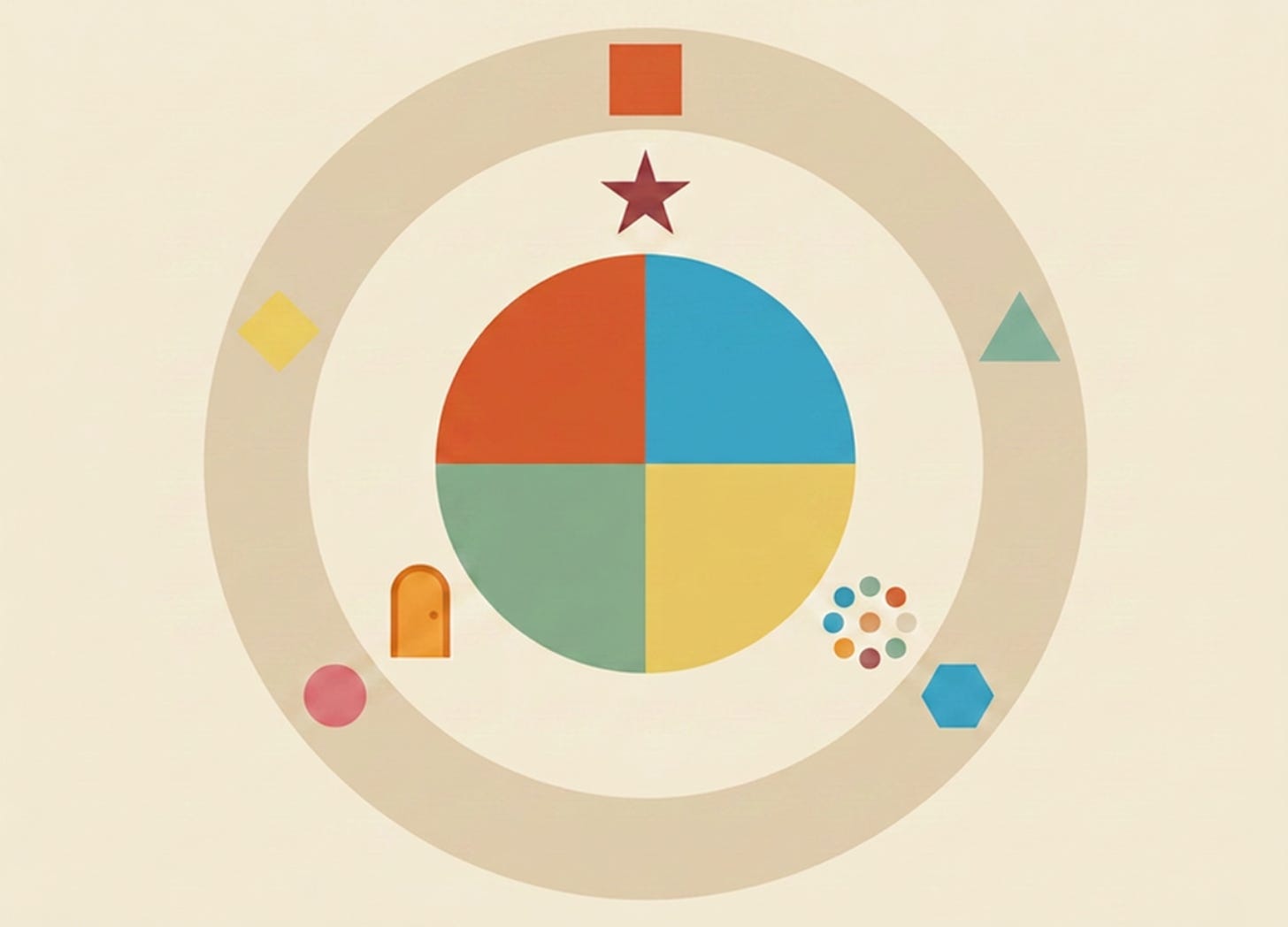
The conditions fall into three rings. The innermost ring comprises the human conditions—four ongoing agendas that need to be tended for any network to hang together and do serious work over time. The middle ring is a set of design principles that run directly counter to how most collaborations are conventionally built. And the outer ring involves the structural supports, the scaffolding that allows people to focus on contributing their best gifts rather than spending their time, money, and attention on the overhead of working together.
Ring One: The Four Agendas
Over many years of training network leaders, we’ve had a very consistent practice. In room after room, we always ask the same question: What does it take to collaborate effectively for systemic change? Participants generated their responses on sticky notes in person, in shared whiteboards online, and we clustered them into distinct areas. And across many sessions, in different countries, with many different kinds of practitioners, the same pattern kept emerging.
We Didn’t Invent These
What emerged wasn’t something that our team designed. It emerged from the collective wisdom of many people. And the process itself was its own proof of concept: a room full of people with different experiences, different contexts, and different parts of the picture collectively naming something that none of them had fully perceived alone.
In fact, the association of these four dimensions—spirit, heart, head, and hands—with the essential conditions for human flourishing is not a new idea. We didn’t invent it.
Te Whare Tapa Whā, the Māori health model developed by Sir Mason Durie in 1984, describes health as a house of four sides: Taha Wairua (spiritual), Taha Whānau (family and emotional), Taha Hinengaro (mental), and Taha Tinana (physical). All four sides are required for the house to stand. Remove any one of them and the structure collapses.
As another, much older, example, the Anishinaabe Medicine Wheel, as articulated here by the Keweenaw Bay Department of Health and Human Services, maps the same four dimensions onto the four directions: emotion, spirit, mind, and physical, with each as essential, interdependent, and pointing toward a distinct aspect of what it means to be whole.
When CoCreative’s training participants clustered their sticky notes into patterns that would become the four agendas, they were, without necessarily knowing it, touching something ancient. The insight that human beings need to be engaged at the levels of spirit, heart, head, and hands to do their most powerful collective work is not a product of the modern systems change field. It has been held by Indigenous knowledge traditions for millennia. What is new, and perhaps telling, is that the dominant, diagnostic, expert-driven approaches to organizational and systems change are finally making space for what these traditions have always known.
We name this not to appropriate these frameworks or claim equivalence, but to acknowledge a resonance that deserves to be honored. And to say plainly: if the conditions for effective collaboration feel deeply human rather than merely technical, that’s because they are.
What Emerged
What emerged we call the Four Agendas, organized by the acronym CALM. We offer them as working hypotheses: conditions we’ve observed holding networks together through complexity, uncertainty, and time. The human conditions. We present them not as a formula, but as a framework for reflection, and a set of questions any network can ask itself about the quality of its own work.
Each agenda is associated with an aspect of the human experience. That’s intentional. One of our deepest convictions about this work is that when you engage all of a person—their spirit, their heart, their head, and their hands—they show up differently, by bringing all of who they are to the work. And when people show up whole, networks become capable of things that no collection of partly-engaged, partly-committed people can achieve.
Connecting (Heart)
The Connecting agenda is about trust. Specifically, it’s about building trusting relationships across the many boundaries that separate people in any multi-stakeholder network, including organizational and sectoral boundaries, but also political, cultural, and historical ones.
This matters more than most people realize going in. Research on change initiatives consistently finds that the level of relational trust among participants is the primary determinant of whether a change initiative succeeds. Not the quality of the strategy or the size of the budget, but the trust.
You know when you’re in the Connecting agenda because you’ve felt it before. When a group has developed genuine relational trust, people are able to take risks they wouldn’t otherwise take. They share what they actually think, including the uncomfortable parts, and others can hear the difficult things with openness and faith. They bring their whole experience into the room, including how the system has harmed them or the people they represent. They have one another’s backs when the going gets hard.
When the Connecting agenda is weak, the other agendas are impaired. Learning becomes shallow because people don’t feel safe enough to share what they actually know. Alignment becomes brittle because disagreement feels threatening rather than generative. And when the network tries to act in the world, as when a member takes a strategy back to their organization and puts themselves out there, they do it without confidence that their network partners will support them if it gets difficult. That’s a lonely and mistrustful place to be.
Aligning (Spirit)
The Aligning agenda is about shared purpose. Not just a mission statement or a list of objectives, but a transcendent purpose that’s big enough, challenging enough, and urgent enough that none of us can accomplish it alone. That’s actually the test: if your network’s goal is something one organization could achieve on its own, it’s not the right goal for a network.
We associate this agenda with spirit because deep alignment around a shared purpose that’s larger than yourself is genuinely a transcendent experience. When a group is truly aligned, and when people feel that they’re giving themselves over to something that matters, together, there’s a quality in the room that’s hard to describe analytically. We feel it.
The Aligning agenda also encompasses how the network works together: the agreements, the norms, and the shared understanding of roles and decision-making. But the core of it is that galvanizing, life-giving imperative. Without it, everything else is maintenance work in search of a reason to exist.
When alignment is weak, the effects are insidious. Connecting happens, but people aren’t sure why they’re there together. Learning shoots off in different directions because there’s no shared purpose to bound and focus it. Making produces strategies that don’t reinforce each other or, worse, that actively work at cross-purposes.
Learning (Head)
The Learning agenda encompasses how a network develops shared understanding of the system it’s trying to change and, importantly, of the lived human experience within that system.
That second dimension is worth pausing on. Networks pursuing systemic change often do reasonably well at learning about system dynamics: the structures, relationships, incentives, disincentives, feedback loops, and leverage points. What they more often neglect is learning about what it’s actually like to live inside the system they’re trying to shift, especially by those most affected by it. And that neglect reliably produces strategies that are structurally coherent but somehow humanly wrong.
The Learning Agenda is also the agenda most at risk of being overdone. In systems change work, there’s a familiar trap: groups that spend months, sometimes years, mapping a system and building shared analysis but never get to the work of actually changing anything. Learning becomes a substitute for action rather than a foundation for it. The head stays busy while the hands stay still. The art is in knowing when you’ve learned enough to act, and then acting and learning from that.
Making (Hands)
The Making agenda is where the network turns its alignment and learning into concrete collective action: strategies, solutions, and interventions that are bigger than any one organization or sector could design and advance alone. This is where we start to talk about “rolling up our sleeves” and “getting our hands dirty.”
This is the agenda that, in a sense, justifies the whole enterprise. It’s what makes the cost and complexity of genuine cross-sector collaboration worthwhile. If what your network produces could have been produced by a single organization working alone, or strategies that will improve rather than transform the system of concern, something has gone wrong somewhere upstream.
Making isn’t just about implementing predetermined plans. At its best, it’s also about prototyping, testing, learning from what works and what doesn’t, and adapting both learning and strategy in real time. The Making agenda is where the network’s collective intelligence becomes tangible—where the emergent strategy we described in Part One actually takes material form in the world.
The Interdependence of the Four Agendas
The four agendas are not a checklist. They’re an interdependent ecosystem, and the easiest way to understand that is to remove one and see what breaks.
Take away Connecting: people don’t feel safe enough to share what they really know, disagree with the direction, or commit fully to shared action. The network operates with everyone holding something back.
Take away Aligning: energy and resources are spent in different directions. Learning is fragmented. Making produces strategies that don’t reinforce each other. People can’t articulate why they’re together.
Take away Learning: the network acts on incomplete or outdated understanding of the system. Strategies are designed without adequate knowledge of what’s actually happening or what people are experiencing. The confidence to act is misplaced.
Take away Making: the network becomes a talking shop. Trust may be high, purpose may be inspiring, understanding may be deep—and nothing changes. The hands never get dirty.
The flip side of this interdependence is synergy. When Connecting is strong, people can challenge and deepen the Aligning agenda because they trust each other enough to disagree. When Aligning is clear, Learning is better oriented and more purposeful. When Learning is rich, Making is better designed and more resilient. Each agenda, when strong, amplifies the others.
One more thing about the four agendas: they’re not static or equally weighted across a network’s life. Early in a network’s development, Connecting and Aligning typically need the most attention. As Allan Drexler and David Sibbet’s Team Performance Model (1988) indicates, the first two questions in any collaboration are one of purpose (“Why are we here?”) and one of trust (“Who are you?”). You already know how natural it is, as we first come together to do something meaningful with others, to focus on building relationships and working out our shared purpose.
As a network matures, Learning and Making come to the foreground. And periodically, typically every year or two, a network needs to return to the Aligning and Connecting agendas with fresh eyes, asking whether its purpose and strategy still fit what it has learned and what the system requires, and who else is needed to understand and shift the system.
A network that attends to all four agendas over time creates something rare: a whole-person experience for its members. When you engage people’s spirit, heart, head, and hands simultaneously, and when the work calls on all of them, not just their professional expertise, people show up differently. They’re more invested and more present, more willing to bring their best. That’s where we start to create the conditions for people to stay in the work, not for weeks or months but years. It’s how collaboratives like the Solar Circle have sustained themselves for decades.
Ring Two: Three Design Principles
While four agendas describe what needs to be tended, these three design principles describe how to build the conditions for that tending to be possible. Unfortunately, each one runs directly counter to how collaborations are often approached.
Start with a powerful shared purpose, not a lowest-common-denominator goal
The conventional wisdom about building collaborative networks is that we need to start by finding what everyone can agree on so we can establish common ground before asking for commitment. This instinct is understandable: after all, why alienate potential partners before they’re even in the room?
The problem is that any purpose that everyone can agree on up front is never powerful enough to sustain the work over time. When we build a network around a goal that’s been negotiated down to the lowest common denominator—that is, the barest statement of intent that no one will object to—we end up with a foundation made of sand. There’s not enough strength in it, not enough energy or urgency, and certainly not enough of a reason to show up when the work gets hard.
What we’ve found instead is that networks cohere most powerfully around a goal that feels almost too big, even scary—what we call a MAST goal: Meaningful, Audacious, Specific, and Timebound. That audacity isn’t irresponsible but magnetic. It attracts the people who feel, in their bones, that something of this scale actually needs to happen. And it turns off the people who were only going to half-commit anyway.
This often means starting not with everyone with positional power but with a small group of people who share a genuine sense of urgency and are willing to draft a working purpose together. We test that purpose, strengthen and clarify it, and let it attract others through what we call “rising resonance,” a deepening and galvanizing quality that builds as the right people find each other around a felt shared imperative.
Be selective, not open-door
The intuition behind open-door network recruitment is generous: the more people, the more diverse the perspectives, the richer the work. But in practice, open invitations send a signal that commitment isn’t really required. The people who show up in response to a general call are not there for the same reasons, don’t share the same urgency, and as the work progresses, find it equally easy to simply not show up.
More importantly, an open invitation that feels open to you doesn’t feel open to everyone. The people least likely to respond to a general call to “join the collaboration” are often the very people whose perspective is most needed—those who have been harmed by the system, who don’t see themselves reflected in traditional leadership, who have no reason yet to believe that this room will be different from the others.
Selectivity, done well, is actually more inclusive than openness. It means being intentional and explicit about who needs to be in the room, why, and what’s expected of them. It means reaching out personally, making the case for why this particular person’s perspective is essential. It means designing the network so that the most impacted people have genuine voice and genuine influence, not just a seat at the table.
Get the whole system in the room, not just the decision-makers
Networks built around traditional leaders and decision-makers have a structural flaw: the people most invested in the current system are the ones designing the alternative. The truth, too often, is that they’re the last to see what needs to change and the first to protect what exists.
What produces richer analysis, more grounded strategy, and more reliable and resilient implementation is getting a genuine cross-section of the whole system in the room together, including the people who are most affected by its failures—not as token representatives, but as full participants whose knowledge of the system is treated as essential rather than supplementary.
To paraphrase one of my favorite lines, attributed to the French diplomat Charles Maurice de Talleyrand-Périgord, there is one body that knows more than anybody, and that is everybody. A network comprising farmers and investors and policymakers and community members and workers and advocates doesn’t just produce better strategy, it becomes a working representation of the system it’s trying to create—which, as I argued in Part One, is itself one of the most powerful things a network can do.
Ring Three: Structural Supports
The four agendas are the human conditions. The three design principles are the architectural choices. But none of it functions without structural supports and the scaffolding that allows people to focus on contributing their best gifts, wisdom, and experience to the work rather than spending their energy on the overhead of working together.
These supports are often the most underinvested dimension of network development, in large part because funders and leaders who are drawn to the inspiring vision of people coming together across their differences to transform a system are sometimes less drawn to the unglamorous work of making sure the infrastructure is in place for that to actually happen. The result is what we described in Part Two as a wishful thinking trap: expecting self-organization to emerge without providing the conditions that enable it.
A backbone organization
Every effective network we’ve worked with has had some form of backbone—that is, an entity or role whose primary job is to hold the network together, not to advance its own or any one member’s agenda. The backbone convenes, communicates, coordinates, and remembers. It manages the administrative and logistical infrastructure that would otherwise fall to whoever is most organized or most available, who is rarely the right person for the reasons that matter.
Research across multi-stakeholder platforms consistently finds that the presence of a neutral backbone organization is among the most reliable predictors of network effectiveness. This isn’t a coincidence. Without it, the connecting and aligning work that needs to happen between convenings doesn’t happen. Trust atrophies. Purpose drifts. The network exists in formal terms but not in lived practice.
Appropriate and adequate resourcing
Networks require real investment. Not just funding for convenings, but funding for the backbone, for the time people need to participate meaningfully, for the facilitation and process design that makes the four agendas possible, and for the long arc of the work, which, as I noted in Part 1, is measured in years and decades, not grant cycles.
The mismatch between network timelines and funding cycles is one of the most persistent structural barriers in the field. A network that is perpetually scrambling for its next year of funding cannot build the trust and momentum that the work requires. Adequate resourcing means not just enough money but the right kind of patient capital, flexible enough to follow where the network’s emergent strategy leads rather than locked to predetermined deliverables.
Just enough governance
Networks need governance, but the wrong kind of governance can be as damaging as none at all. We’ve seen networks strangled by governance structures designed for organizations, like boards, bylaws, and formal voting procedures, that were imported wholesale into a context where they don’t fit and where they actively undermine the relational, adaptive, and emergent qualities the network needs.
What effective networks require is what philosopher Alicia Juarrero frames as enabling constraints rather than governing constraints: agreements and structures that create clarity about how decisions get made, how conflicts get navigated, and how new members are brought in, without creating bureaucratic overhead that slows us down and makes participation itself feel like work.
The test for governance in a network is simple: does this structure make it easier or harder for people to show up fully and contribute their gifts and wisdom? If the answer is harder, then your governance approach needs to change.
Meaningful feedback processes
Networks operating in complex systems need ways to know whether they’re on track, not through the blunt instrument of predetermined outcome metrics, but through feedback processes that are sensitive to what’s actually happening in the system and in the network itself.
This includes both internal feedback (e.g., how are the four agendas developing? where is trust strong and where is it thin? is our shared purpose still the right one?) and external feedback (what signs is the system showing us about the effects of our strategies? what’s emerging that we didn’t anticipate?). The Learning agenda depends on this infrastructure. Without it, learning stays at the level of opinion and impression rather than becoming a genuine collective resource.
Skilled facilitation
Finally, and this is the one support that is most often treated as optional, effective networks require skilled facilitation. Not just good meeting design, but the ongoing human capacity to hold the space, navigate conflict productively, deepen all four agendas, help the network make sense of its own experience, and, most importantly, cultivate a genuinely human experience that’s meaningful and even joyful as we work together.
Facilitation is not a luxury or an add-on. It’s the human skill that animates all the other structures. A backbone organization without skilled facilitation is coordination without wisdom. A convening with the right people and the right purpose, but without skilled facilitation, often produces frustration rather than insight. The question isn’t whether to invest in facilitation but how to ensure that the capacity is there, whether through an external partner, a skilled internal convener, or both.
An Invitation
These three rings represent what our team at CoCreative has learned so far. We hold them with both conviction and humility. They’re working hypotheses, not a prescriptive system.
What do you know that we don’t? What conditions have you seen make the difference between a network that transformed something and one that disappointed? What’s missing from this picture?
The most powerful thing about a framework like this is that it gets better when more perspectives and people are in the conversation. That’s not a platitude but the core argument of this entire series. Please leave a comment. Start a thread. Tell us what you’ve seen.
And if you’re ready to move beyond reading about these conditions and start experiencing them directly, we’re developing opportunities for exactly that kind of experiential, action-oriented learning for funders and leaders who want to build both the conviction and the practical knowledge to bring these approaches more fully into their work. More on that soon.
This is the third article in a three-part series. Part One explored the four superpowers of intentionally built networks. Part Two examined the sources of resistance to network approaches and what they’re pointing toward.
Free resource from CoCreative: Network Health Balanced Scorecard, a practical tool for assessing the strength of the four agendas in your network and supporting meaningful conversation about what’s working and what needs more attention.
Russ Gaskin is founder and co-owner of CoCreative, a consulting and training organization specializing in network weaving, systems change strategy co-design, and facilitation of multi-stakeholder collaborations.