

Networks Succeed Where Programs Fail, Part 2
What Gets in the Way of Network Approaches

This is the second article in a three-part series. Part One explores the superpowers of effective networks. Part Three explores the enabling conditions that separate networks that transform systems from networks that disappoint.
If you read the first article in this series, you know that well-designed networks possess extraordinary superpowers: Forging genuine ownership rather than inducing buy-in, driving change simultaneously across multiple levels and fronts, building the resilience to last for decades, and becoming experiential microcosms of the future they are trying to create. The evidence for this is compelling and growing. The examples I gave are real. And increasingly, leaders and funders across philanthropy and systems change are paying attention, especially those who have witnessed a well-functioning network firsthand.
And yet.
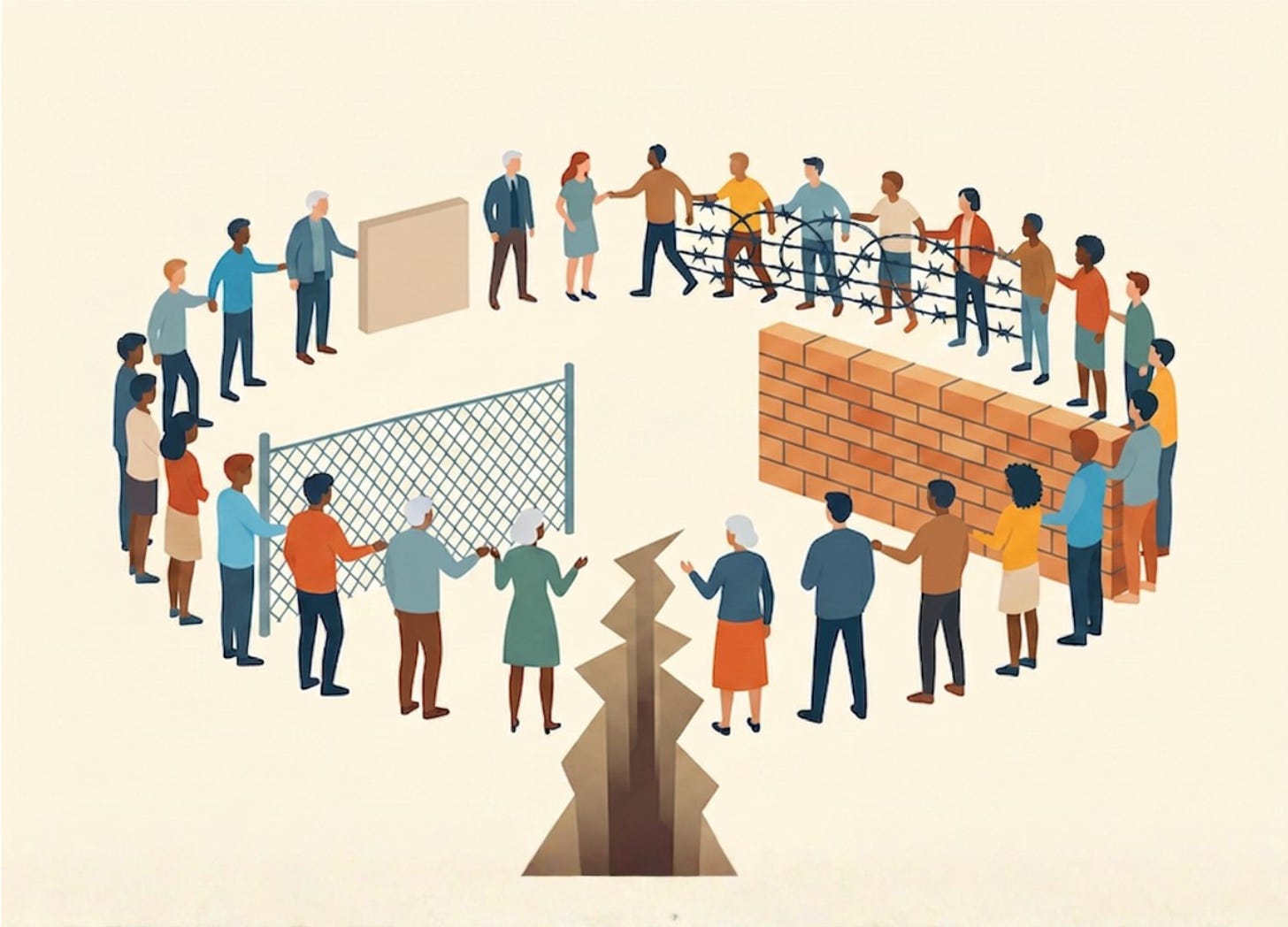
And yet, despite growing interest, despite growing evidence, despite the genuine enthusiasm of many program officers and systems change leaders, the shift toward network-based approaches remains too slow to meet our growing challenges. People who are motivated to embrace these approaches still find themselves held back. The case has been made, but something remains in the way.
This article is an attempt to unpack that “something.” Not to try to argue people out of it, but to listen carefully to what it’s actually saying. Because in my experience working with networks across sectors and continents over many years, the hesitations I hear most often aren’t irrational. They’re signals. They’re pointing toward something real about what networks require, about ways of working that our institutions haven’t yet learned to support, and about the conditions that the philanthropy and systems change fields still needs to develop collectively.
The barriers fall into two broad categories. The first is structural and institutional and concerns the ways our existing frameworks, approval processes, funding models, and governance structures make it really difficult to commit to network-based approaches, even when the will and interest is there. The second is experiential, about the ways that our lived experience of collaboration, or the absence of genuine and meaningful collaborative experiences, shapes what we believe is possible and what we’re willing to try.
Both matter. And both are worth understanding clearly so we can work with them more effectively.
Thread One: The Rationalization Gap
For many of the funders and leaders I’ve worked with, the biggest barrier to adopting network approaches isn’t belief. It’s rationalization. There’s a real difference between being motivated to engage in a network-based approach and being able to make the case for it within your institution. I’ve watched program officers who genuinely believe in this work struggle to translate that belief into something their foundation’s decision-makers can get behind. The motivation is there. The institutional understanding to carry it forward isn’t.
This gap shows up at every level of philanthropic organizations.
At the program officer level, the challenge often begins with strategic fit. Effective networks advance multiple diverse interventions at once as part of a holistic and integrated strategy that often doesn’t map neatly into discrete program areas or funding priorities. A program officer who wants to support a multi-stakeholder collaborative on, say, food systems transformation may find that it doesn’t belong neatly in the environment portfolio or the economic mobility portfolio or the health portfolio, and yet it belongs in all three. The silos that organize foundation strategy are built for a different kind of philanthropy, and otherwise supportive program officers often find themselves either self-censoring—deciding not to bring the idea forward because they can’t see a path through the internal approval process—or trying and failing at the next level up.
At the board and trustee level, the concerns cluster around three things I hear repeatedly: clarity of mission, strategic fit, and measurable impact. These aren’t unreasonable governance concerns. Trustees are accountable for the foundation’s resources and reputation, and they’re operating within frameworks built for program-based philanthropy. They want to know: How does this advance our priorities? What will we be able to point to? How will we know if it worked? These are legitimate questions. The problem isn’t the questions—it’s that network-based approaches require different answers than those frameworks were designed to produce.
At the field level, there is what I think of as the lone funder problem. Few funders want to carry a network alone. The reputational and financial exposure of being the only institution willing to bet on a collaborative approach, especially one whose outcomes can’t be predicted in advance, is genuinely uncomfortable. I recently spoke with a program officer who is the sole funder of a multi-sector collaborative she deeply believes in. She’s not questioning the network’s value. She’s questioning how long she can continue to rationalize the absence of other funders to her board. The loneliness of that position is real, and it’s a structural problem, not a personal one.
Where I’ve seen these barriers successfully navigated, it’s almost always because the risk has been shared or offset in some way. Partners for a New Economy, as a funder collaborative, provides its constituent foundations a means to experiment with network funding outside their individual institutions’ structures and processes. In this way, it functions as a kind of philanthropic skunkworks, a space where member foundations can learn about network-based approaches without having to work that learning through their own decision-making gates. Similarly, when Luzette Jaimes and I facilitated a systems change learning journey with The Funders Network in 2019, something unexpected happened: by the end of the cohort, the thirty or so program officers who’d participated began to see themselves not just as individual advocates within their own foundations, but as a nascent ecosystem working to shift philanthropy itself toward these kinds of approaches. They had, almost without realizing it, become a network in service of funding networks.
There’s something worth pausing on in that story. The solution to the rationalization gap, at least at the field level, turns out to look a lot like the solution being proposed in Part 1: people with a shared imperative, building trust and collective strategy together, finding they can do something collectively that none of them could do alone. The field of philanthropy needs its own networks to fund networks, with some strong examples already in play, like the Pando Fund, the Global Methane Hub (which itself emerged from a network approach), and Partners for a New Economy.
Underlying all of these structural barriers is a knowledge gap that compounds everything else. Most funders and leaders don’t yet have reliable frameworks for assessing whether the conditions for an effective network are in place (or can be reliably developed) before committing, or for reading early indicators that a network is developing the health and coherence it needs to be effective over time. Without those frameworks, the investment feels like a leap of faith rather than an informed bet. And leaps of faith are hard to rationalize to a board.
Thread Two: The Experience Gap
While the structural barriers are real and significant, underneath them is a possibly more fundamental barrier: The experience gap.
Most leaders and funders haven’t personally experienced what genuinely generative, dynamic collaborative work feels like. Sure, we’ve been in plenty of meetings. We, funders at least, have even sat in plenty of multi-stakeholder gatherings. But if we’re honest, we need to admit that most of those experiences involved a lot of talk and not much walk: lots of conversations, some lowest-common-denominator agreements, often-dominant voices filling the room while others stayed quiet, and outcomes that didn’t justify the time invested. The aftereffect of that kind of experience of collaboration has real effects. It’s shaping what we believe is possible, what risks feel worth taking, and what we’re able to imagine when someone describes an intentionally built network as a vehicle for systems change.
This is both a personal gap and an organizational one. The foundations and institutions that seem most well-positioned financially and mission-wise to fund or participate in network-based approaches are sometimes among the most hierarchical in their own organizations. When co-creation and emergent strategy aren’t how an organization actually operates internally, it can be very difficult to believe that those approaches can work at a larger, messier, cross-organizational (and especially cross-sector) scale. When it comes to it, I think we just have a hard time fully trusting a process we’ve never experienced.
I see the difference clearly when I work with funders whose organizational cultures embody relational, humble, co-creative ways of working, ones where listening is treated as a source of learning and insight rather than an obligation, where co-creation isn’t (just) a value statement but a lived practice in how teams make decisions. Those funders bring a different quality of confidence and imagination to network approaches. They’re not just intellectually persuaded. They have an experiential reference point. Contrast that with program officers at more hierarchical foundations, who may be deeply motivated but whose own institutional experience provides no evidence that emergence and co-creation actually work.
There’s a related limiting belief: The assumption that people only sustain commitment to a collaborative if there’s sufficient direct institutional self-interest in the outcome. This belief, left unexamined, produces networks built on a weak foundation. When a network’s purpose is essentially a negotiated intersection of its members’ individual organizational interests, what you get is what I call a “lowest-common-denominator” intent. It’s not powerful enough, not transcendent enough, and not meaningful enough to hold people together through the complexity and difficulty and uncertainty that serious systems change work necessarily involves.
What actually holds networks together over time isn’t institutional self-interest. It’s what we call rising resonance, a deepening, galvanizing shared purpose that attracts people with a felt personal imperative around the issue. These are leaders who already know, in their bones, that their organization cannot solve the challenge alone, but that solving it is imperative. They’re held in high regard by their peers not for their titles but for their passion and their competence. They combine deep expertise in their part of the system with genuine curiosity and humility about what they don’t know. And they’re able to navigate fluidly and creatively between their own organizational interests and the common purpose, not by suppressing the tension but by working with it creatively an generatively.
Finding those people, and creating the conditions for rising resonance to develop, requires a different theory of network recruitment than most institutions are currently using. And it requires a goal big enough and meaningful enough to justify the approach. One of the most consistent things I hear from skeptical but open-minded leaders is some version of: Why would we go through the cost and complexity of genuine cross-sector collaboration for a goal that we could probably achieve on our own? That’s not a bad question. After all, the goal has to be large enough, audacious enough, and urgent enough to make the pain and the cost of collaboration not just worthwhile but obviously necessary. The tension isn’t between ambition and realism. It’s between the kind of galvanizing moral imperative that networks need to cohere around and the kind of measurable, target-based goals that funders and institutions are typically equipped to evaluate.
Finally, the most important and underappreciated thing, in my mind, about bridging the experience gap: We can’t argue people across it. No amount of evidence, no collection of case studies, no well-reasoned article (including this one) can fully substitute for direct experience of a different way of working.
When we were developing the Clean Electronics Production Network, we spent months in conversation with representatives from two large technology companies we knew the network needed. We explained the collaborative innovation process carefully. We shared examples of what the first convening might produce. But we were careful, rightly, not to pre-specify the strategies or priorities the network would develop—because those needed to emerge from the collective. And that open-endedness, however intellectually honest, was precisely what the company representatives couldn’t rationalize to their institutions. They couldn’t answer the question their leadership would ask: what exactly are we agreeing to?
What broke through wasn’t a better explanation. It was an invitation. We asked representatives from those two companies, along with a small group of NGO representatives, a government official, and a worker advocacy representative, to give us an afternoon and a morning. We’d take them through a miniature version of the process we would use at the network’s launch convening. About eight people in the room. Low risk. No commitment other than to give it a try.
We drafted a powerful intent together, built a landscape map, identified critical shifts, and began sketching strategies.
By noon the next day, sitting in a circle, my co-facilitator and I asked, “Okay, if this is the kind of process we’d use in this network, are you in?”
Everyone said yes.
What moved the company representatives wasn’t the output (though the output was good). It was the experience of being in a room where company reps and worker advocacy leaders were working collaboratively rather than adversarially. For the first time, they felt what it was like to have their different knowledge of the system leveraged together rather than deployed against each other. That felt different—and really good. And that difference was something they could take back to their institutions and describe from the inside rather than the outside.
This is, I’ve come to believe, one of the most important and underutilized tools in the systems change field: the demonstration experience. Not a pilot program. Not a proof of concept in the traditional sense. A direct, embodied taste of a different way of working—low-risk enough to say yes to, real enough to change what you believe is possible.
What the Barriers Are Telling Us
Looking across both threads of both the rationalization gap and the experience gap, a pattern emerges. These barriers aren’t primarily about skepticism. Most of the leaders and funders I work with aren’t fundamentally opposed to network-based approaches. Many are in fact drawn to them. What they’re missing is the vocabulary to make the case within existing institutional languages, the frameworks to assess and evaluate these approaches with confidence, and the direct experience that would make their conviction feel grounded rather than aspirational.
That points toward something both personal and collective. At the personal level, it suggests that the most powerful thing a motivated funder or leader can do isn’t to read more case studies or attend more conferences. It’s to find ways to directly experience generative collaborative work, and then use that experience as the basis for making the case within their institution. And funder collaboratives, when they’re truly collaborative, are a terrific place to experience this.
At the field level, it points toward a set of things the philanthropy and systems change community still needs to develop together: Shared frameworks for assessing network readiness and health, better evaluative language for emergent approaches, and more structural vehicles like funder collaboratives and dedicated experimental spaces that allow motivated institutions to take informed risks without bearing the risk and exposure alone.
The barriers are plainly telling us what the field’s unfinished business is. And the good news is that none of this is insurmountable. Yes, it requires investment, collective learning, and the willingness to build the enabling conditions that network-based approaches need to thrive—which is, of course, itself a network challenge.
We’ll look at what those enabling conditions look like in Part Three.
In the meantime, for those ready to stop reading about a different way of working and start experiencing it, we are developing opportunities for exactly that kind of direct, experiential learning—for funders and leaders who want to build both the conviction and the practical knowledge to bring network-based approaches more fully into their work. More on that soon.
This is the second article in a three-part series. Part One explored the four superpowers of intentionally built networks. Part Three will explore the enabling conditions that separate networks done well from networks that disappoint.
Interested in how you can fund or start an effective network? CoCreative can help with coaching and training.
Russ Gaskin is founder and co-owner of CoCreative, a consulting and training organization specializing in network weaving, systems change strategy co-design, and facilitation of multi-stakeholder collaborations.