

What Is Experiential Systems Change?
Our experience of change itself may be the most undervalued condition for systemic change.

This article was inspired by conversations with members of the CoCreative team, Melissa George Kessler, Anna Birney, and Sean Khaya Andrew.
Over the years, our team at CoCreative has developed an informal set of principles that we apply to our work. They include things like:
Differentiate before we integrate (to help people honor their diverse perspectives and interests before going for agreement).
If I can’t say no, then my yes means nothing (to ensure that shared decision-making is real, not performative).
Bring the difference that’s missing in the system (e.g., if a group is stuck in analysis, we’ll bring the energy of action).
Never be more committed to the work than our client (because, well, this is just a recipe for disaster).
And there’s one principle that we seem to come back to often:
Whatever’s getting in the way of the work IS the work.
It sounds almost like a Zen koan, but it means something very practical. When groups of people come together to collaborate on systemic change, they often want to move as quickly as possible to the big, system-shifting work: the analysis, the strategy, the interventions. But often, the thing slowing them down is not a lack of analysis or strategy. It’s the experience they’re having of working together.
I was talking recently with my colleague Tema Okun about this. She described what happens in some of the change collaborations she’s supported: people arrive carrying a sense that something is not working, that dynamics in the room aren’t being named, that some voices are being heard and others aren’t, but nobody says this out loud. Everyone wants to focus on the “big” work of systemic change. Instead, the collaboration moves forward on the surface (discussing strategies, making plans) while the unaddressed dynamics continue to drain our energy and limit what’s possible. The work before us, in those moments, is not the strategy but the experience.
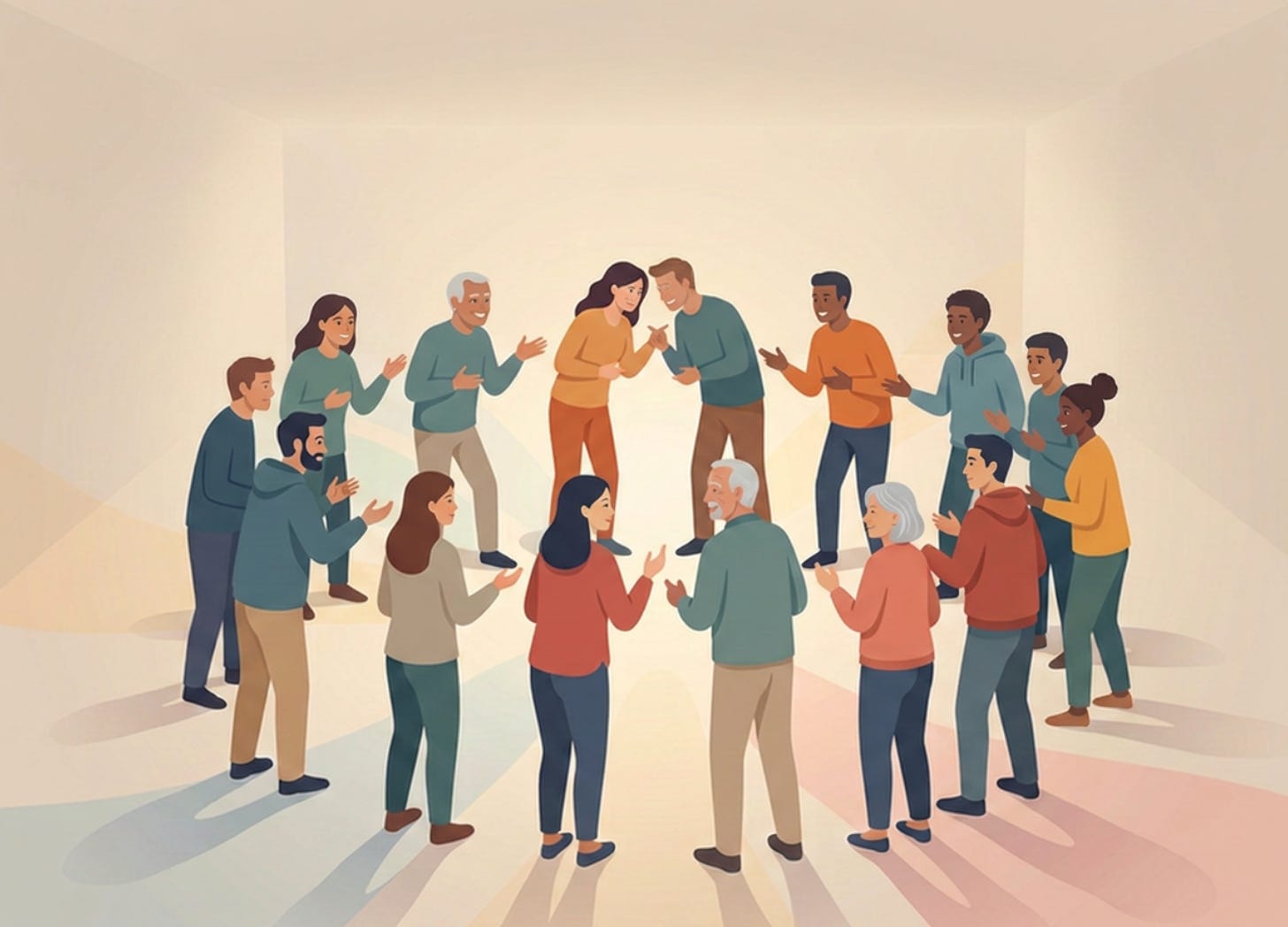
Sometimes we have to slow down, or stop entirely, and do a reset together. Change the quality of the experience people are having. Acknowledge what hasn’t been said. Shift the conditions so people can actually show up. When that works, people open up and lean in, energy returns, and people recommit. A sense of inclusion, agency, and individual and collective voice starts to emerge. People shift from saying “you need to do this” to “we need to do this.”
That shift is experiential and points to something about systems change practice that we don’t yet pay enough attention to.
An Extension, Not a Replacement
In earlier work, I’ve described dialogic systems change as the idea that truly transformative change operates through the meanings people make together in real-time conversation. In 4 Stories of Experiential Systems Change, I shared four stories that illustrate what designing for experience looks like in practice, and named six dimensions of experience worth designing for:
people’s experience of the system itself,
their experience in the room,
their experience of the work over time,
their experience with and of each other,
their experience of the future they’re working toward, and
their experience of themselves in the work.
Here, I want to step back and articulate the underlying framework: the principles that make experiential systems change distinctive, and why they matter.
I don’t mean this as a replacement for dialogic systems change. Dialogue and generative meaning-making are essential. But the dialogic frame doesn’t fully capture what we’re most trying to create together. It’s not just that we want more meaning-full conversations. We want changed experiences of the system, of each other, of ourselves, and of what’s possible. And that requires us to think of ourselves not just as hosts of meetings and dialogues, but as designers of experience.
John Kania, who, along with Peter Senge and Mark Kramer, adapted the work of Donella Meadows into the more practice-able Water of Systems Change framework, recently proposed extending the framework’s deepest level from “mental models” to include “embodied sensemaking.” His argument: the word “mental” misrepresents how humans actually make meaning. More than 80% of the sensory information that reaches the brain comes through the body. Somatic experience, relational presence, and felt sense are doing more of the heavy lifting of meaning-making than cognitive reframing alone. In other words, we don’t only understand and experience reality inside our brains, but directly with our feelings and bodies.
Seven Possible Principles
Seven principles may define experiential systems change (if you have others, or you disagree with my list, please comment below!). This draft list describes both why experience is central to systemic work and how to design for it.
1. There are always two systems.
When we set out to change a complex social system, we rarely account fully for something Steve Waddell calls a Societal Change System: the ecosystem of diverse actors who are collectively driving change in the target system. This “change system,” meaning the ecosystem of individuals and organizations who are working together toward transformation, is a system in its own right. And its effectiveness depends on whether the people within it have the enabling conditions to work well together: shared intent, trusting relationships, the capacity to learn and adapt, a genuine sense of agency and collective efficacy.
The quality of experience within the change system determines whether those conditions exist. We can’t manufacture trust through a governance structure, even a great one, nor can we generate genuine shared intent through a strategy session. These things emerge, or don’t, from the accumulated experience people have of working together. Attending to the experience of the change system is not preliminary to the real work. It is real work.
2. Experience precedes and enables understanding.
We tend to assume that people change what they do when they change what they think. Decades of research suggest the opposite is closer to the truth. Festinger and Carlsmith’s foundational work on cognitive dissonance showed that acting against one’s beliefs, even for minimal reward, causes people to revise those beliefs to match their behavior. Daryl Bem later formalized this into Self-Perception Theory: we don’t just act on what we believe; we come to believe what we see ourselves doing.
The implication for systems change is that we cannot reason our way into a changed system. We have to experience our way there. New beliefs, new relationships, and new possibilities follow from new experiences, not the other way around. What we experience in the room about the system we’re trying to change or about what might become possible among us are the real mechanisms, not just the methods, of systemic change.
We cannot reason our way into a changed system.
We have to experience our way there.
3. Our experience of a system is critical knowledge about that system.
The most important knowledge about how a system actually works rarely lives in documents, data sets, or expert reports. It lives in the experience of people inside it. What people know in their bodies from years of navigating its structures, absorbing its exclusions, feeling the difference between what the system promises and what it actually delivers, is irreplaceable information. No analytical framework can reconstruct it. No survey can fully capture it.
Whenever our team at CoCreative is helping develop a new collaboration, we do many interviews to develop two pictures of a system:
The view of how the system itself is operating (e.g., the dynamics among its elements)
The view of the lived experience people are having in that system
These are not the same thing, and to fully understand any system, we must understand both.
4. All the enabling conditions for systemic work are experientially determined.
Trust. Inclusion. A sense of agency and voice. The courage to name harm and misuse of power. The commitment to stay in the work when it gets hard. These are the conditions that make transformative collaboration possible. And they are not downloaded through good process design. They emerge from, or are even undermined by, the quality of experience people have with each other over time.
The most common source of failure in systems change collaborations is not weak analysis or poor strategy. It is the gradual erosion of the conditions for genuine collaboration: the presence of performative inclusion, the withholding of authentic voice, the accumulation of unaddressed moments when the experience of being in the work felt dismissive or unsafe. Attending to those moments, naming them, and working to change them is part of the critical path to systemic change.
Systems change operates on long time cycles, measured in years if not decades. People’s experience of the work is what determines whether they stay in the work over time. When the experience is good (or good enough), people keep showing up, contributing their analysis, their relationships, their willingness to be changed by the process. When it isn’t good, they drift away—rarely dramatically, usually gradually, and seldom out loud. The strategy may be sound and the theory of change solid, but without the people who sustain the effort over time, neither matters. A collaboration that loses its people hasn’t lost its way, but its capacity for change.
5. Complexity requires multiple ways of knowing.
Analytical knowing, including careful diagnosis, pattern recognition, and logical analysis, is necessary but not sufficient for working with complex human systems. At CoCreative, we have found that working effectively with complexity requires access to at least three other ways of knowing: emotional knowing, which helps us sense the resonance of a problem or desire; intuitive knowing, which gives us insight into situations too large or nuanced for our conscious minds to hold and process; and somatic knowing, the felt sense of understanding that arises from bodily experience rather than intellectual reasoning.
These different ways give us access to different things. Antonio Damasio’s somatic marker hypothesis showed that bodily sensations guide decision-making before conscious awareness engages. The HeartMath Institute’s research on heart rate variability found that the heart generates signals before the brain reacts to an event. These aren’t mystical mysteries but physiological realities with direct implications for how we design change processes. If we design exclusively for analytical knowing, we leave most of what people know about the system, and about themselves, on the table.
6. Start with experience and work backwards.
Steve Jobs told a room of developers in 1997: “You’ve got to start with the customer experience and work backwards to the technology.” The same principle applies here. Most facilitation design starts with the agenda (the content, the process, the outcomes) and treats experience as something to be optimized at the margins. Experiential design inverts this. It starts with the question: what experience do we most want people to have? What do we want them to feel about the work, about each other, about what’s possible? And then works back to the structures, methods, and conditions that enable that.
This applies across the full arc of the work. What experience of the system do we want to invoke at the start of a collaboration, where our early patterns and culture start to quickly form? What experience of one another do we want people to have by the time we’re making hard strategic choices together? What experience of themselves, of their own agency and significance, do we want people to carry back into their lives when the formal work ends?
7. Experience extends beyond the room.
The change we’re working toward isn’t just a change in what people decide or do. It’s a change in what people experience as both real and possible. And that extends beyond the boundaries of any meeting or convening space.
When we describe a possible future, through a strategy, a vision, or a scenario, we are inviting people into an experience of it. What does it feel like to be in that future? Do they see themselves there? Can they bring their gifts? Does it feel like an invitation to a better party, or a place where they will be displaced, diminished, or irrelevant? The answers to these questions determine whether people will work toward that future we’re describing. A rigorous theory of change presented as a future in which many people cannot locate themselves will not generate the commitment needed to drive systemic change.
This is also how experiential change radiates outward. The agriculture sector leader I described in 4 Stories of Experiential Systems Change didn’t transfer a framework back to his company. He transferred an experience of what working together could feel like that he had lived and therefore knew how to enable.
An Expanding Field of Practice
Several organizations and approaches are actively developing the practice of experiential systems change, each emphasizing different dimensions.
CoCreative’s Collaborative Innovation approach builds multi-stakeholder change systems through structured dialogue for shared sensemaking, emergent strategy, and co-ownership of both analysis and action. Our Beyond Analytical Knowing framework supports practitioners and groups to access emotional, intuitive, and somatic ways of knowing alongside cognitive analysis, recognizing that the complexity of human systems is too large and nuanced for analytical knowing alone to hold.
Collective Change Lab has extended the Collective Impact framework by centering relational and healing dimensions that structural approaches tend to omit. John Kania’s recent proposal to evolve the Six Conditions to replace “mental models” with “embodied sensemaking” is one of the field’s clearest articulations of the experiential turn, and their Systems Storytelling approach invites system actors to share stories of lived experience rather than analytical diagnoses, accessing knowledge that reports and data cannot.
Social Presencing Theater, developed by Arawana Hayashi at the Presencing Institute, uses movement, body, and stillness to make invisible systemic dynamics visible and felt. Rather than analyzing a system from outside, participants embody elements of it and discover through the body what the system is actually doing and what wants to shift.
Systemic Constellations adapts Bert Hellinger’s family constellations work to organizational and wider social systems. Practitioners like Charles O’Malley describe working with “embodied knowing,” in which participants standing in as representatives of system elements receive an intuitive, felt sense of how the system is organized and how it might be different. The process creates what O’Malley calls “living maps” — representations of a system that reveal patterns no diagram can communicate.
Somatic Art Therapy uses creative expression and somatic awareness to access meaning and aspiration that cognitive processes don’t reach. Working with the Spiritual Change Makers Collaborative, this approach produced a purpose statement that emerged from embodied yearning rather than semantic negotiation — arriving at language the group recognized as true in their bodies before the analytical mind had fully processed it.
Nora Bateson’s Warm Data Labs create structured encounters with the relationships within complex systems, rather than the elements themselves. Participants experience complexity directly rather than analyzing it, developing what Bateson calls “warm data”: relational, transcontextual information that lives in the interrelationships between parts of a system rather than in any single part.
Stuart Candy’s Experiential Futures work explicitly designs immersive encounters with possible futures. Not presentations about futures, but lived experiences of them. The premise is that futures people have experienced are more real and more actionable than futures we have only heard described.
Claudia Tordini of the Experiential Learning Lab has pioneered Sensorial Problem Solving, an approach in which a problem gets translated from a cognitive frame into shifts in our sensory experience between the current and future states, and then translated back into cognitive terms.
(This list is a sample, and almost certainly biased by my own experience and research. Do you have other examples? Please share in the comments below.)
A different relationship with change
In the dialogic frame, the guiding question for practitioners is: are we creating the conditions for genuine shared meaning-making? The experiential frame adds a question that sits underneath that one: how are we designing for the experience people are having of the work itself?
These aren’t competing questions, but nested ones. Answering the second changes how we approach everything, from our pre-work to our physical environments to our choice of methods, what check-ins we use, and what stories we tell about what’s possible. It changes what we notice when something isn’t working and what we reach for when we need to reset.
Colleagues have each asked me some version of this question: how do we know when the experience of a systems change collaboration is good (powerful, meaningful, joyful) enough for people to do the work the system needs from them? I don’t have a clean answer. But I think it’s one of the most important questions in the field right now.
The room is the intervention, not just a container for the work. It’s the medium through which the deepest change becomes most real. To practice that isn’t to add a tool to our facilitator’s toolkit, but to change our relationship with the work itself.
Related Horizons of Change articles:
4 Stories of Experiential Systems Change: Our experience of change is a key driver, not just the method, of systemic change
The Emergence of Dialogic Systems Change: Are we seeing two different models of change, or a fundamental evolution of the field?
What Is Dialogic Systems Change? The shift from diagnosing systems to changing the conversations that hold them in place.
Reference List
Bem, D.J. (1972). Self-perception theory. In L. Berkowitz (Ed.), Advances in Experimental Social Psychology (Vol. 6, pp. 1–62). Academic Press.
Damasio, A. (1994). Descartes’ Error: Emotion, Reason and the Human Brain. Putnam.
Festinger, L., & Carlsmith, J.M. (1959). Cognitive consequences of forced compliance. Journal of Abnormal and Social Psychology, 58(2), 203–210.
Kania, J. (2026, March). From mental models to embodied sensemaking. Collective Change Lab. https://collectivechangelab.substack.com/p/from-mental-models-to-embodiment
Waddell, S. (2016). Societal change systems: A framework to address wicked problems. The Journal of Applied Behavioral Science, 52(4), 422–449.
Waddock, S., Waddell, S., Jones, P.H., & Kendrick, I. (2022). Convening transformation systems to achieve system transformation. Journal of Awareness-Based Systems Change, 2(1), 77–100.
Russ Gaskin is the founder and co-owner of CoCreative, a consulting and training organization specializing in network weaving, systems change strategy co-design, and facilitation of multi-stakeholder collaborations.
You can learn more about Russ and the thinking behind this publication on the About page.
Everything happens in relationship! You might be interested in Organisation and Relationship Systems Coaching (ORSC) building on the work of Marita Fridjhon and Faith Fuller. https://www.crruk.com/what-is-organisational-relationship-systems-coaching/