

How System Change Networks are Rolling their Own Funding
Don't wait for funding to appear, make it happen as part of your shared work

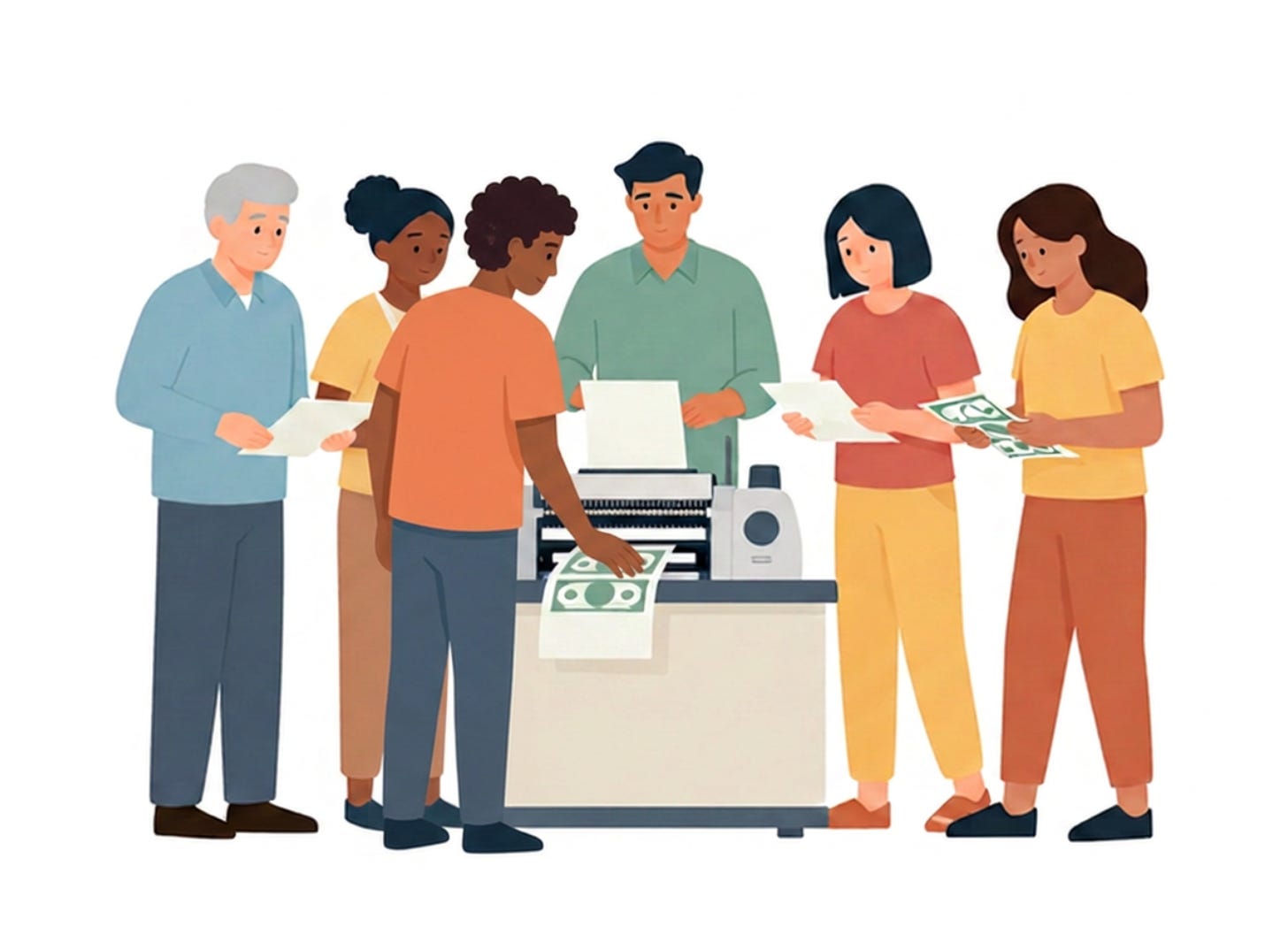
A funder has brought together a set of organizations they believe should be working together and offered grants to each of them contingent on showing up with the others. The organizations show up. They do the work they were paid to do. They report back. But the collaboration that was supposed to emerge among them? It appears in the meeting notes but doesn’t come alive in the room.
I’ve come to call this the “arranged marriage” problem. If you’ve funded or convened systems change work, you’ve almost certainly encountered some version of it.
Anna Muoio, in a recent dispatch from her Theory of We substack, has mapped the structural architecture that produces these patterns in careful and useful detail. Her eight challenges to what she calls “Pando Funding” include loss of control, risk aversion, uncertain outcomes, the problem of funding invisible infrastructure, and the difficulty of funder coordination. They are worth understanding if you want to make sense of the environment you’re operating in. These barriers are real, deeply embedded, and changing, slowly.
This article isn’t for people who want to change the system of philanthropy, but for people who are working to shift other systems—and who need funding to do it. I’ll share where the funding landscape is actually opening up, and name the strategies that are working right now for collaborations that have figured out how to build the funding they need.
A Critical Reframe: Funding is Part of the Change Work
Most systems change collaborations treat funding as a parallel track. The work happens somewhere else in the organization, by someone whose job is to find the money to sustain it, while everyone else does the “real” work. The two streams intersect occasionally in grant reports, but they’re managed separately, as if they’re fundamentally different kinds of problems.
The collaborations that have cracked this are the ones that have stopped treating the funding challenge as organizational overhead and started treating it as part of their shared strategy. As one example, in February 2021, a multi-stakeholder network of NGOs and funders working in the climate change space identified adequate and equitably distributed funding as a collective priority. They formed a working group where funders and NGO leaders worked together on the problem. By November of that year, they had $250 million in new commitments. That’s not a fundraising result but a key element of a systemic change strategy. If the challenge you’re taking on is systemic, then your funding model and approach should be systemic too.
This reframe has practical implications. Funding strategy belongs on the agenda of collaborative sessions, not only in separate grant-writing efforts done in a back room. Funders in your network are participants in the funding strategy, not just passive providers of funds. And the question shifts from “who will pay for this?” to “how do we collectively resource what we’ve decided matters most?” And a strong, aligned network of leaders approaching funders together with the same ask can be a powerful signal to funders of both shared intent and clear commitment.
If the challenge you’re taking on is systemic, then your funding model and approach should be systemic too.
Starting Earlier and Smaller: The Two-Stage Model
One of the more elegant (and systemic) approaches to emerge in recent years is staged funding, where a funder (or another funder working in tandem), provides a modest seed grant to test whether a viable collaboration exists before they or a larger partner funder commits to a larger investment.
Rider Pool Foundation and the local United Way pioneered this in Greater Lehigh Valley, Pennsylvania. Rider Pool offered $25,000 seed grants to potential collective impact initiatives, just enough to do the exploratory work needed to determine whether a real collaboration could form. Promising initiatives could then approach the United Way of the Greater Lehigh Valley with a collective impact initiative that had already been tested and validated. The formalized relationship between the two funders offered leverage opportunities for the smaller foundation while reducing risk for the United Way. In late 2024, the Robert Wood Johnson Foundation launched Justice Squared using a similar two-stage model for cross-sector health equity collaboratives. (Our team at CoCreative supported the co-design process for this program. To see the research that informed it, visit racialequityinhealth.org.)
Even where this model isn’t in place, the lesson here is about the pitch as much as the model. Not “fund this collaboration” but “fund us to find out whether this collaboration is a bet worth making.” That can be an easier ask for most funders, and it produces far better evidence of what you actually have when it comes time to ask for more.
Building a Statewide or Regional Tier
Early Matters Texas is a network of nine collective impact initiatives working on early childhood success across the state. The statewide tier does what is difficult to impossible for single local initiatives: access state-level and national funding, work on statewide policy, and distribute resources equitably across member initiatives.
If your collaboration has the opportunity to develop a statewide, regional, or field-level tier, that tier becomes a powerful funding vehicle. State and national funders who won’t fund a local initiative will often fund infrastructure that coordinates multiple local initiatives. The statewide tier is relevant to a different class of funders, and it gives them something many are looking for: evidence that the work is building toward durable change without depending on any single community to deliver it.
Funder Collaboratives and Pooled Funds
One of the structural shifts Muoio’s piece identifies as difficult is funder coordination, where foundations face the same collaboration challenges they’re asking grantee networks to solve. This is true, and slowly changing.
Partners for a New Economy, Co-Impact, The Abundant Futures Fund, and a growing number of pooled funding vehicles are demonstrating that coordinated funder investment is possible, and that it offers advantages no single foundation can provide alone. Pooled funds allow funders to take collective positions, distribute risk, signal to the field that multiple serious funders see a body of work as a priority, and, maybe most helpfully, release participating funders from their own internal constraints, allowing more room for experimentation and learning.
The more recent twist is that some multi-stakeholder collaborations are now coalescing their own funder collaboratives. We see this work happening around transforming systems of governance, gold mining in the Amazon Basin, and several other areas where, together, diverse stakeholders are partnering with funders to cultivate more resilient and systemic funding ecosystems to support more systemic work over longer periods.
Speaking their Language, Not Yours
“Backbone organization supporting systems change” communicates something real to someone who has worked in the collective impact field for fifteen years. It communicates very little to a foundation program officer reviewing a hundred proposals in a week.
The discipline of translating collaborative work into outcome-focused language, while placing both into a clear systemic strategy, is learnable, and it matters more than most conveners acknowledge. “We coordinate fourteen organizations, so they’re not duplicating services and can create more opportunity for twice as many people living in poverty” is a different sentence. Both can be true, but one of them gets you a meeting.
The larger principle: funders are navigating real institutional pressures. The more directly you connect your work to outcomes they are accountable for, reduced emergency room visits, increased graduation rates, restored watershed health, whatever, the easier we make it for advocates inside their institutions to champion the work.
Explicitly Connecting Near-Term Wins to Long-Term Strategy
One of the most consistent findings across collective impact research is that collaborations with the strongest funding relationships make the connection between near-term results and long-term systems change explicit, rather than leaving funders to connect the dots themselves.
“We reduced emergency room visits in this zip code by 12% this year. Here’s how that connects to the systemic change we’re working toward in 3-5 years.” Language like this validates the funder’s investment and gives them a story to tell their board about why the longer-term bet makes sense. The team at Strive Together, one of the most documented collective impact networks in the US, has been public about their difficulty funding coordination work even after years of demonstrated results. Their lesson: set the expectation about the need for long-term investment early, not after you’ve already built something and need to sustain it.
Enrolling Funders as Whole People
David Shaffer, chairman and co-CEO of Just Born, the company that makes Peeps and much of the candy sold at movie theaters, eventually stopped accepting applications from individual nonprofits. His new requirement: multiple organizations needed to come together and show him a shared approach. David cared about the issues that these organizations were working on and came to understand that truly systemic change required more than any single organization could deliver. To help enable these partnerships, he would make suggestions, introduce people, and help create the conditions for their collaborations to work. He was personally, not just financially, invested in the work.
Donors are whole human beings with their own fears and aspirations. Most don’t want to be treated as bank accounts. The collaborations that build the strongest funding relationships are the ones that invest in giving funders direct exposure to the actual texture of the work, like site visits, unscripted conversations with people in the system, and honest accounts of what’s failing alongside what’s working. Mastercard Foundation made this real at an institutional scale: they moved headquarters to Kigali, shifted the majority of their staff to Africa, and committed that decisions affecting African communities would be made in Africa. What looked like a policy change was actually a proximity change—the kind that changes both the analysis and priorities.
The funding landscape for systems change collaborations is more open than it was five years ago. The structural barriers Muoio catalogues are real, but alongside them, something else is also true: a growing number of funders have experienced what generative collaboration produces, and they are actively looking for more of it. Our work is to make sure they find us, and to build the kind of funding relationships that treat what we’re doing not as a program to be evaluated, but as a shared strategy worth owning together.
For more funding ideas for your network, see the 2026 Collective Impact Summit session, Funding the Movement, Not Just the Moment, I delivered with my colleague Melissa Darnell.
Russ Gaskin is founder and co-owner of CoCreative, a consulting and training organization specializing in network weaving, systems change strategy co-design, and facilitation of multi-stakeholder collaborations.
Great post, Russ.
Two notes of concern:
1) even seed funding is hard to find
2) pooled funds appear to have sizable resources to make sizable impact BUT, BUT, BUT they also centralize power