

Fear is Not the Thing We Have to Fear
Part 1 of The Unexpected Benefits of Fear, Conflict, Failure, and Resistance

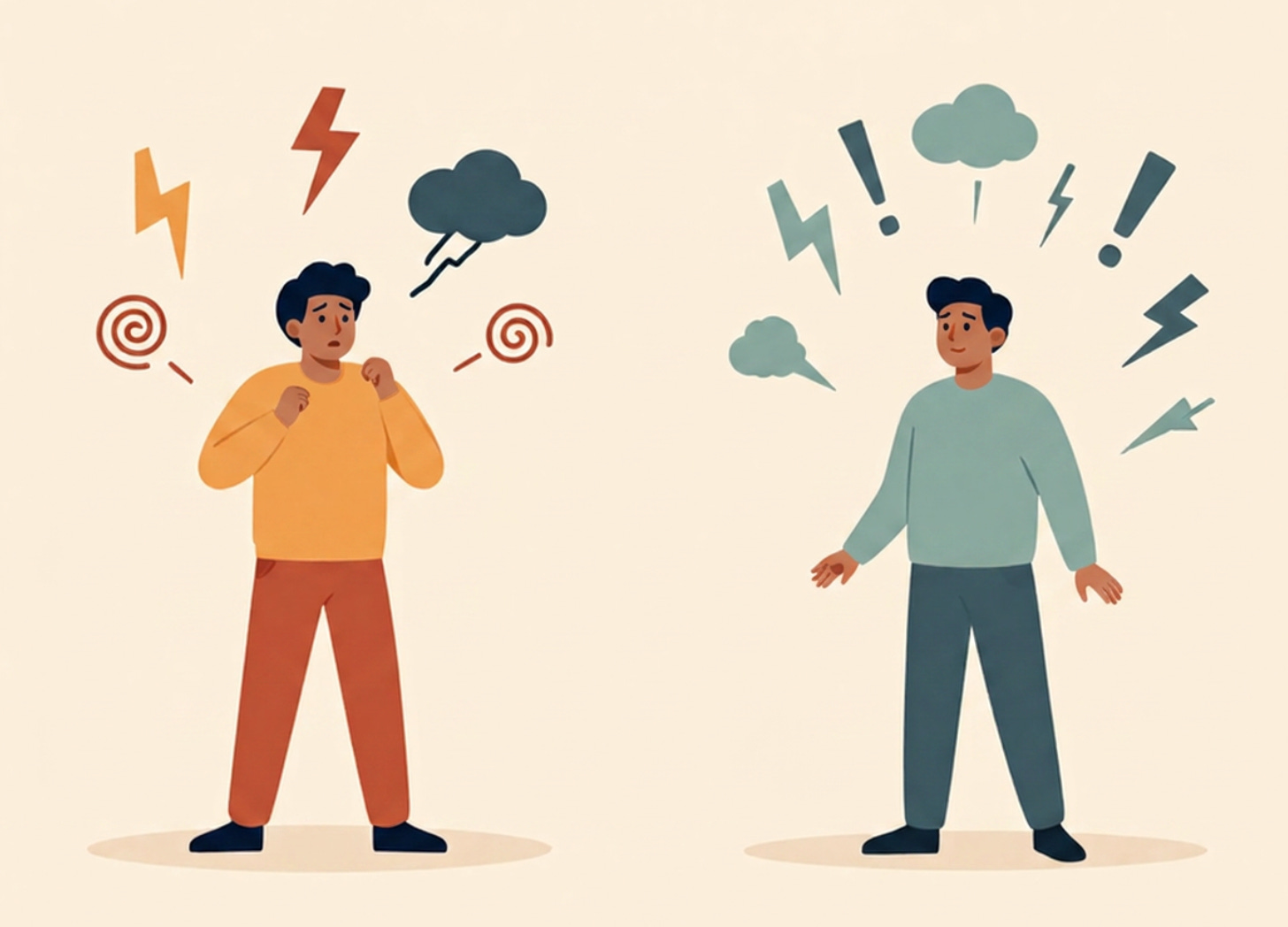
In his first inaugural address in 1933, Franklin Delano Roosevelt told a nation gripped by economic collapse that “the only thing we have to fear is fear itself.” It was a galvanizing call to action, an invitation to stop allowing fear to paralyze us and start moving forward together. But vocalist and performance coach Jennifer Hamady, in her book The Art of Singing, offers a quiet but important alternative: “We have nothing to fear but an unhealthy relationship with fear.”
That single reframe is the animating idea behind this series of four articles on what we at CoCreative call “the Baddies,” the experiences that tend to derail collaborative work, the ones we most reliably try to avoid, suppress, or push through. But what if the problem was never the thing itself? What if fear, conflict, failure, and resistance are not obstacles to doing good work together, but essential ingredients in it, resources waiting to be recognized and used? That is the argument I’ll explore across all four articles:
Part 1: Fear is Not the Thing We Have to Fear
Part 4: That Resistance You’re Getting? It’s Trying to Help You.
Let’s start here, with fear.
A Story About Fear
I have a long relationship with fear.
I grew up in Rushford, Minnesota, a beautiful postcard-ready town nestled in the forested hills of the southeast corner of the state. For me, it was the perfect place to enjoy nature, and do all I could to avoid speaking with the other 1,317 people who lived there.
To say I was quiet and shy as a kid is a hell of an understatement. I literally didn’t speak until the age of 4. Through elementary school, I was silent most days unless called upon by the teacher, where I would answer correctly but as efficiently as possible, because I knew that my voice would give away my fear if I said more than a few words at a time.
My social anxiety was paralyzing. One August Sunday, when I was 8, I was sitting in the hard wooden pews of our church, trying to stay awake. Most days like that, I could blend into the brown pew and become invisible. But this day the minister came over to me and, speaking directly to me in front of the whole congregation, said, “Russell, would you like to help collect the offering today?”
It was a simple task: pass a basket down one row, collect it at the next, and continue down the aisle.
My response was equally simple: I broke out in tears, dropped to the floor between the pews, and tried to disappear.
Even today, at 58, I have fears. I’m afraid of driving across the 4.3-mile Chesapeake Bay Bridge. I’m afraid of those escalators that rise seemingly unsupported inside malls. I’m still afraid sometimes before I give a talk. But here’s one big difference between 8-year-old me and 58-year-old me: I’m no longer afraid of being afraid.
Two things have changed in my relationship with fear:
First, I can now speak in front of people, which is probably a good thing since I earn my living from it.
Second, I’ve come to appreciate the many benefits that fear can deliver, if only we learn to embrace them.
I’ve come to appreciate the many benefits that fear can deliver, if only we learn to embrace them.
What Fear Is
Fear is an emotion that arises when we believe someone or something is threatening the loss of something we value. The threatened something may be our lives, our status, our safety, anything that we don’t want to lose. That’s the simple definition, and I think it’s good enough to work with for now. But fear is also something more: it’s energy, a forecast, a signal from our past, and perhaps most importantly, a source of insight.
Research in neuroscience confirms what wisdom traditions have long suggested: fear is fundamentally adaptive. It evolved to help us survive and respond to a changing world. The problem isn’t the fear itself; it’s when fear becomes disconnected from actual threat, when it metastasizes into something chronic, unnamed, and unexamined.
One important note: the ability to develop a healthy relationship with fear assumes some degree of safety and agency. For people being threatened by oppressive governments, psychological trauma, or real physical harm, fear is often a completely rational and healthy response to real danger. What we’re exploring here isn’t about minimizing fear. It’s about changing how we relate to it.
What an Unhealthy Relationship with Fear Looks Like
An unhealthy relationship with fear typically begins when we try to repress or ignore it. The feeling doesn’t disappear; it goes underground, where it shapes our behavior in ways we can’t easily see or name. In groups and collaborations, this is especially corrosive. When fear becomes undiscussable, it doesn’t stop operating. It just operates below the surface.
When we’re in an unhealthy relationship with fear, we tend to shut down or spin out. Our perceived range of options narrows dramatically, and where we once saw many paths forward, we suddenly see one or two, both of which may look bad. We actively search out enemies. We might assume we’re the only one feeling what we’re feeling. We freeze, procrastinate, or retreat to the comfort of the familiar. All these dynamics constrain choice, agency, and the challenge we need to grow in healthy, adaptive ways.
Our fear also doesn’t respond well to others trying to manage it, or to disparagement or dismissal. Telling someone to “push past their fear” or “be rational” almost always makes things worse. Fear needs affirmation, information, and reassurance. It responds to compassion. This is as true in collaborative settings as it is for individuals.
Fear needs affirmation, information, and reassurance. It responds to compassion. This is as true in collaborative settings as it is for individuals.
In collaborative work specifically, fear of losing influence, being sidelined, or looking incompetent can quietly drive some of the most destructive group dynamics: the withdrawn participant, the dominating voice, the person who agrees in the room but undermines the work outside of it. Most of the time, no one names what’s actually happening. They don’t need to suppress the fear because it has already suppressed itself.
The Benefits of a Healthy Relationship with Fear
Here is what changes when we stop treating fear as an enemy and start treating it as information.
Fear tells us we care. When I feel fear in my work, it almost always signals something that matters to me—a relationship, an outcome, maybe a value I don’t want to compromise. One participant in a CoCreative webinar (on this very topic) described walking into a courtroom to represent himself in a personal case, feeling fear rise up, and instinctively perceiving it as bad. But then something shifted. He realized that the fear wasn’t bad, that it was telling him what was really important to him. That reframe didn’t eliminate the fear but channeled it. He showed up more focused, more present, and more effective.
Fear tells us we’re learning something important. John Carter, one of my teachers, once said that “If you’re not feeling fear or anxiety, then you’re not really learning.” It takes courage to uncover and take on our most awkward learning edges, often the ones that matter most. When we are genuinely learning new ways of thinking or being, the territory is unfamiliar and uncomfortable, and we experience what Martin Broadwell called “conscious incompetence,” the critical stage of learning where we risk looking like fools. That discomfort is a signal to proceed mindfully, not a stop sign.
Fear connects us to others. When I’ve dared to name my fear in a relationship or collaborative setting, to say “I’m worried about this” or “I don’t know if I can do what’s being asked of me,” others recognize themselves in what I’ve said, and shared experience flows. The group or the other person becomes more honest, and therefore more capable. Sometimes, simply sharing what we’re experiencing with honesty and vulnerability is the most powerful act of leadership available to us.
Fear is a signal worth reading. As a forecast, fear alerts us to risks we haven’t fully recognized, to assumptions we’re making about the future, or to past experiences that may or may not be relevant now. It can tell us when our thinking has become extreme, when we’re reacting to echoes of the past rather than being present now, or when we’re being protective of something that genuinely deserves protection.
Fear, worked with rather than against, builds presence and capacity. Performers who have no fear, Jennifer Hamady observes, tend to give dull performances. The energy of fear, channeled rather than suppressed, sharpens focus and presence. The same is true in collaborative work: the groups that have learned to work with their collective fears tend to be more alive, more honest, and ultimately more effective than those that have learned to perform fearlessness.
Practices for Developing a Healthier Relationship with Fear
No single practice works for everyone, and the practices below are invitations rather than prescriptions. But across years of working with groups navigating difficult terrain, these are the ones we return to most.
Name it. The simple act of acknowledging fear, to yourself or aloud in a group, begins to shift your relationship with it. You don’t even have to resolve it. Just name it.
Respond with compassion, not dismissal. When fear shows up in others, resist the urge to minimize or push past it. Acknowledge what’s present, invite people to fully feel it, offer information where it’s helpful, and create enough safety that the fear can be expressed rather than driven underground.
Get out of your head and into your body. Fear lives in the body before it lives in the mind, and the mind is often the worst place to process it. We’re too good at catastrophizing, too quick to spin stories. Slow your breathing. Notice what’s happening in your chest, your jaw, your belly. Shift your attention there. You might even ask that part of your body what it’s trying to tell you.
Get outside yourself. Fear feeds on rumination, especially the replaying of worst-case scenarios until they feel inevitable. Before a high-stakes meeting that could open doors to working directly with members of the U.S. Congress on cross-partisan policy design, I was so caught up in my own anxiety that I was guaranteeing failure. My coach Bob Dickman offered a simple reframe: stop thinking about yourself and start thinking about them, their pressures, their needs, what success looks like from their side of the table. That shift turned my fear into focus.
Clarify the threat. Vague fear is often the most paralyzing kind. Turn a general fear into a specific one: what exactly am I afraid of? What is the actual worst-case scenario? Naming the specific fear, even catastrophizing it deliberately, often reveals that the threat is either more manageable than imagined or real enough to warrant a concrete response.
Center on purpose. When fear narrows your vision, return to why this work matters. Your larger purpose, in life, in the collaboration, in the specific moment, can provide a stabilizing frame that fear alone cannot.
Seek awe. Experiences of awe in nature, in art, in the presence of something larger than ourselves have a remarkable capacity to place our fears in perspective. This isn’t escapism. It’s recalibration.
In groups: make fear discussable. Create the conditions in which people can name what they’re afraid of without it being treated as weakness or disloyalty. The fears that go unspoken don’t disappear. They shape every conversation that follows.
As Roosevelt knew, paralyzing fear is real and its costs are high. But the answer was never to eliminate fear. It was to find our way to a healthier relationship with it. Fear is not the enemy of good collaborative work. An unhealthy relationship with fear is. And that, unlike fear itself, is something we can change.
Coming next in this series: Part Two: What If the Conflict IS the Breakthrough?
If you’d like to develop a healthier relationship with fear, my colleague Issac Carter offers coaching and tools that will help. You can reach Issac through the CoCreative website.
Russ Gaskin is founder and co-owner of CoCreative, a consulting and training organization specializing in network weaving, systems change strategy co-design, and facilitation of multi-stakeholder collaborations.